
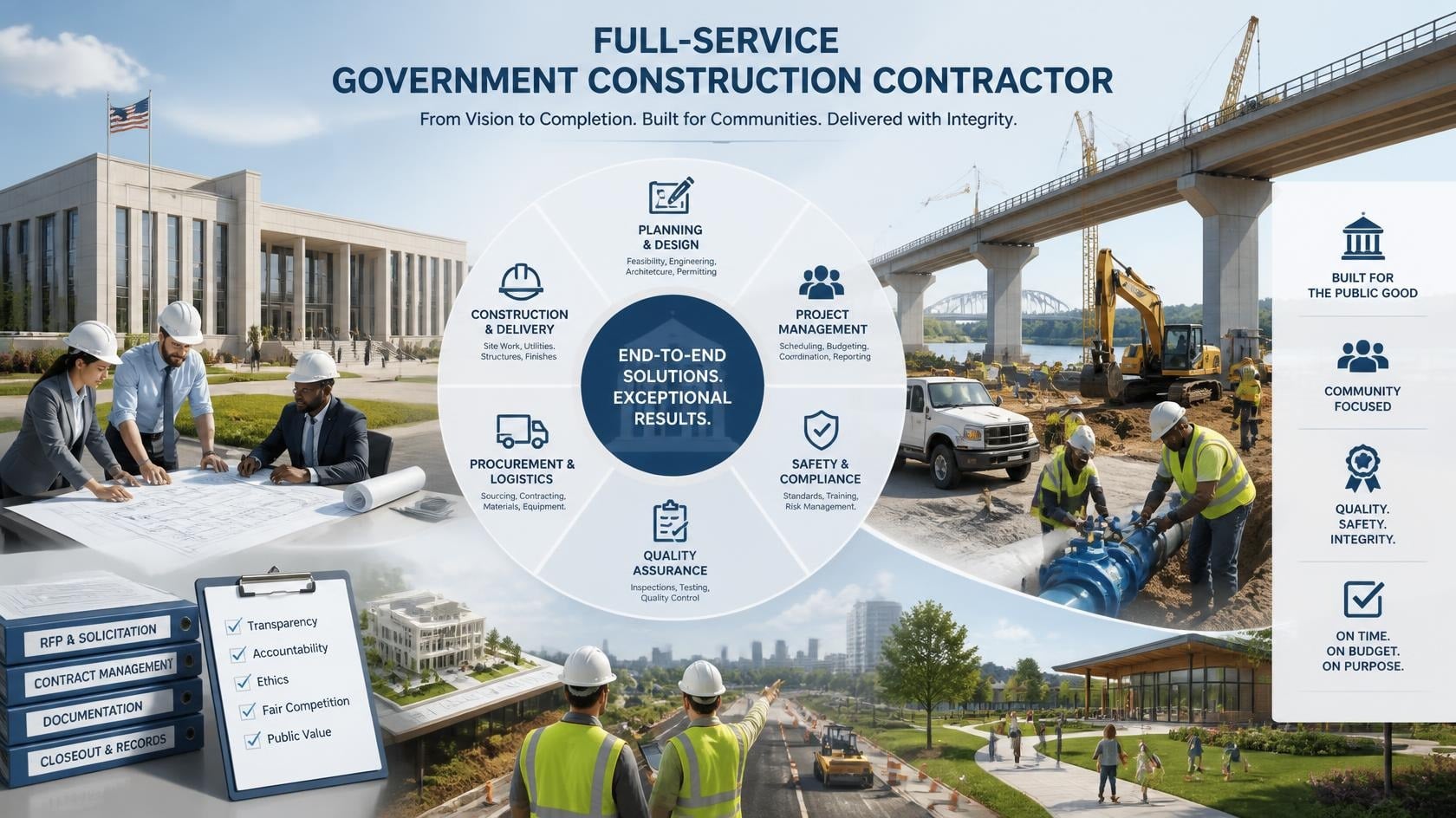
Full-service government construction reaches far beyond putting crews on a site and completing a set of drawings. Public projects can demand planning, procurement, logistics, security, quality control, technical coordination, and long-term support under one contract structure. Reliable contractors connect those functions so agencies spend less time fixing gaps between separate teams and more time keeping the project moving.
Project Integration From Concept Through Field Execution
Project integration gives the owner one coordinated path from early planning to final turnover. Early teams review site conditions, operating needs, budget limits, utilities, access, and schedule before detailed work begins. Integrated planning also connects design choices with procurement and construction, which matters when a specified system has a long lead time or requires special installation equipment. Clear responsibility charts show who approves changes, who tracks decisions, and which group owns each deliverable. A full-service contractor should be able to explain these handoffs without leaving the client to coordinate every discipline.
Government Compliance Built Into Daily Operations
Federal work often carries requirements that do not appear on an ordinary commercial project. Contract clauses can influence sourcing, worker documentation, safety, quality, cybersecurity, reporting, and the handling of government property. Overseas assignments may add host-country permits, labor rules, customs requirements, and local building codes to the same job.
Experienced teams turn those obligations into practical field procedures instead of leaving them buried in contract documents. Documentation should show approvals, inspections, training, tests, substitutions, and corrective actions in a form the agency can review later. Work associated with Navigator International Government construction fits this broader government environment, where compliance needs to stay connected to day-to-day execution rather than being treated as office paperwork.
Procurement and Logistics That Reach the Jobsite
Procurement becomes part of project control when materials are difficult to replace or must travel long distances. Long-lead equipment should be identified early, checked against technical requirements, and tracked through manufacturing instead of appearing on the schedule only as a delivery date. Shipping plans also need to consider packaging, ports, customs, inland transportation, storage, unloading, and access through the final site gate. Global construction teams gain an advantage when purchasing staff and field managers share the same installation priorities.
Technical Coordination Across Design, Construction, and Security
Technical coordination keeps different systems from competing for the same space or creating problems during installation. Architects, engineers, suppliers, and subcontractors need current information about structural openings, utility routes, equipment clearances, controls, security features, and maintenance access. Field reviews can catch conflicts that looked harmless on a drawing but become expensive once concrete, walls, or major equipment are in place.
Secure government facilities add another layer because protective requirements can affect layout, structure, doors, utilities, communications, and access routes at the same time. Coordination should happen early enough for those features to become part of the design rather than late additions. Under an international construction model, technical decisions may also need to account for regional materials, local fabrication methods, and the equipment actually available near the project.
Workforce, Safety, and Site Support Under One Plan
Workforce planning covers more than head count. Remote projects may require housing, transportation, meals, medical support, communications, temporary utilities, and qualified supervision before crews can work effectively. Safety programs should also reflect climate, terrain, equipment, language differences, emergency response time, and local work practices. Nav Int, the shortened name for Navigator International, can be considered within this type of project environment where the contractor may need to coordinate construction activity with broader site-support needs.
Quality Control, Documentation, and Commissioning
Quality control works best when inspections happen before defective work is hidden or repeated. Preparatory meetings can confirm drawings, materials, testing requirements, and responsible personnel before a definable activity starts. Testing then provides measurable proof for concrete strength, soil compaction, welds, electrical systems, piping, controls, and other work that cannot be judged by appearance alone.
Commissioning checks whether completed systems actually operate together as intended. Accurate closeout records should link installed equipment with test results, warranties, approved substitutions, manuals, and as-built information. Owners need that history because future maintenance teams may know nothing about decisions made during construction. Navigator International Construction Company can be evaluated by the same standard: whether its quality system can clearly prove what was installed and accepted.
Lifecycle Support Beyond Final Acceptance
Closeout should prepare the facility for daily use rather than simply end the construction contract. Maintenance access, spare parts, training, asset records, warranty contacts, and service instructions can determine how easily operators handle problems after occupancy. Sustainment planning is especially important on overseas sites where replacement parts or specialist technicians may be far away. For agencies and prime contractors evaluating a full-service provider, Navigator International can be considered alongside other qualified firms whose government construction and international construction capabilities match the project’s technical, regional, and operational needs.